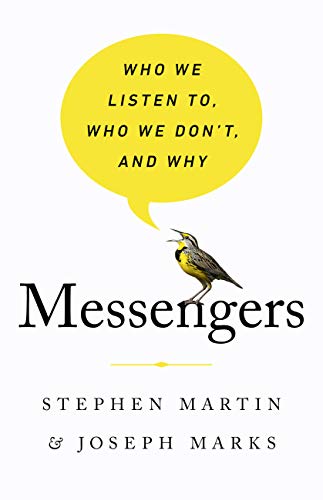
Messengers : who we listen to, who we don't, and why / Stephen Martin and Joseph Marks.
Material type: TextPublisher: New York : PublicAffairs, 2019Copyright date: ©2019Edition: First US editionDescription: vi, 328 pages : illustrations ; 25 cmContent type:
 - text
- unmediated
- volume
- 9781541724389
- 1541724380
- 302.2 23
- BF637.C45 M355 2019
 Books
Books
| Item type | Current library | Call number | Status | Barcode | |
|---|---|---|---|---|---|
|
Books
|
Centervilles Fiction | 302.2 (Browse shelf(Opens below)) | Not for loan | 1000000487 |
Includes bibliographical references and index.
Introduction -- The Curse of Cassandra -- PART ONE. Hard Messengers -- 1 Socio-Economic Position -- Fame, Fortune and Being Recognised without Being Recognised -- 2 Competence -- Expertise, Experience and Why Potential Beats Reality -- 3 Dominance -- Power, Superiority and When Command Trumps Compassion -- 4 Attractiveness -- Cute Babies, Beauty Taxes and the Upsides of Averageness -- PART TWO. Soft Messengers -- 5 Warmth -- Likeable Leaders, Humble Servants and When Cooperation Defeats Conflict -- 6 Vulnerability -- Self-Disclosures, Identifiable Victims and How Openness Can Unlock Closed Minds -- 7 Trustworthiness -- Core Principles, Conflicts of Interest and Those Who Are as Faithful as Their Options -- 8 Charisma -- Vision, Surgency and the Mystery of Magnetism -- ConclusionListening... Believing... Becoming .
"We live in a world where proven facts and verifiable data are freely and widely available. Why, then, are self-confident ignoramuses so often believed over thoughtful experts? And why do seemingly irrelevant details such as a person's appearance or financial status influence whether or not we trust what they are saying, regardless of their wisdom or foolishness? Stephen Martin and Joseph Marks compellingly explain how in our uncertain and ambiguous world, the messenger is increasingly the message. We frequently fail, they argue, to separate the idea being communicated from the person conveying it, explaining why the status or connectedness of the messenger has become more important than the message itself. Messengers influence business, politics, local communities, and our broader society. And Martin and Marks reveal the forces behind the most infuriating phenomena of our modern era, such as belief in fake news and how presidents can hawk misinformation and flagrant lies yet remain."-- Provided by publisher.
There are no comments on this title.