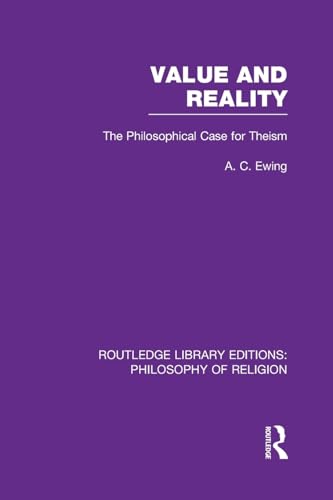
Amazon cover image
Image from Amazon.com

Value and Reality The Philosophical Case for Theism

By: Language: English Publication details: Oxford Routledge 20160520Edition: 1Description: 288 pISBN:
  • 9781138986657
Summary: This is a major work by one of the best-known philosophical writers, representing the culmination of some twenty-five years’ work on the possibility of giving a rational defence of the claims of the religious man, and specifically the theist, in the face of modern criticisms. Dr Ewing’s object has been to fulfil what seem to him the two most important tasks for the philosopher in at least the present age, namely, to see if it is still possible to give a rational defence of a genuinely religious point of view, and to do the same thing for an objective ethics, a task he has attempted in other works, and continues here. The conclusions are that while there can be no question of strict, logical proof, an ethical theism can be defended rationally as an explanatory, metaphysical hypothesis and there are no grounds to reject as illusory the most fundamental intuitive convictions of religion. The book, originally published in 1973, included a new theory of the ultimate criterion of truth for hypotheses, a restatement of the case for a substantial self and for indeterminism, a fresh treatment of the moral and certain other arguments for God, some points in the discussion of the problem of evil and some speculations on time.
Item type:
Tags from this library: No tags from this library for this title. Log in to add tags.
Star ratings
    Average rating: 0.0 (0 votes)
No physical items for this record

This is a major work by one of the best-known philosophical writers, representing the culmination of some twenty-five years’ work on the possibility of giving a rational defence of the claims of the religious man, and specifically the theist, in the face of modern criticisms. Dr Ewing’s object has been to fulfil what seem to him the two most important tasks for the philosopher in at least the present age, namely, to see if it is still possible to give a rational defence of a genuinely religious point of view, and to do the same thing for an objective ethics, a task he has attempted in other works, and continues here. The conclusions are that while there can be no question of strict, logical proof, an ethical theism can be defended rationally as an explanatory, metaphysical hypothesis and there are no grounds to reject as illusory the most fundamental intuitive convictions of religion. The book, originally published in 1973, included a new theory of the ultimate criterion of truth for hypotheses, a restatement of the case for a substantial self and for indeterminism, a fresh treatment of the moral and certain other arguments for God, some points in the discussion of the problem of evil and some speculations on time.

There are no comments on this title.

to post a comment.