testing all
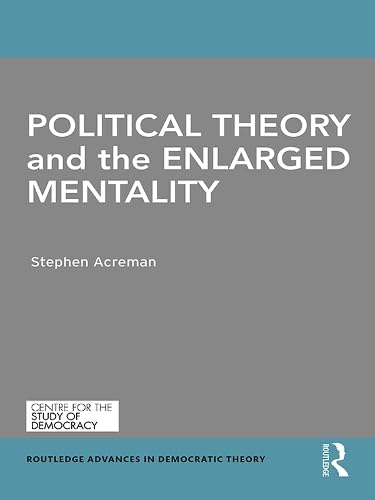
Amazon cover image
Image from Amazon.com

Political Theory and the Enlarged Mentality

By: Language: English Publication details: Oxford Routledge 20171020Edition: 1Description: 128 pISBN:
  • 9781317212409
Summary: In this book, Stephen Acreman follows the development and reception of a hitherto under-analyzed concept central to modern and postmodern political theory: the Kantian ein erweiterte Denkungsart , or enlarged mentality. While the enlarged mentality plays a major role in a number of key texts underpinning contemporary democratic theory, including works by Arendt, Gadamer, Habermas, and Lyotard, this is the first in-depth study of the concept encompassing and bringing together its full range of expressions. A number of attempts to place the enlarged mentality at the service of particular ideals–the politics of empathy, of consensus, of agonistic contest, or of moral righteousness–are challenged and redirected. In its exploration of the enlarged mentality, the book asks what it means to assume a properly political stance, and, in giving as the answer ‘facing reality together’, it uncovers a political theory attentive to the facts and events that concern us, and uniquely well suited to the ecological politics of our time.
Item type:
Tags from this library: No tags from this library for this title. Log in to add tags.
Star ratings
    Average rating: 0.0 (0 votes)
No physical items for this record

In this book, Stephen Acreman follows the development and reception of a hitherto under-analyzed concept central to modern and postmodern political theory: the Kantian ein erweiterte Denkungsart , or enlarged mentality. While the enlarged mentality plays a major role in a number of key texts underpinning contemporary democratic theory, including works by Arendt, Gadamer, Habermas, and Lyotard, this is the first in-depth study of the concept encompassing and bringing together its full range of expressions. A number of attempts to place the enlarged mentality at the service of particular ideals–the politics of empathy, of consensus, of agonistic contest, or of moral righteousness–are challenged and redirected. In its exploration of the enlarged mentality, the book asks what it means to assume a properly political stance, and, in giving as the answer ‘facing reality together’, it uncovers a political theory attentive to the facts and events that concern us, and uniquely well suited to the ecological politics of our time.

There are no comments on this title.

to post a comment.