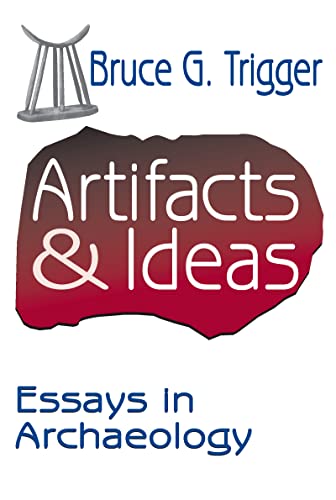
Artifacts and Ideas Essays in Archaeology
Language: English Publication details: Oxford Routledge 20070315Edition: 1Description: 254 pISBN:- 9781412806503
| Item type | Current library | Collection | Vol info | Status | Date due | Barcode | |
|---|---|---|---|---|---|---|---|
 Books
Books
|
Centervilles General stacks | Reference | Vol. 1 (16/05/2025) | Checked out | 23/05/2025 | 1000000387 | |
|
Books
|
Centervilles General stacks | Reference | Vol. 2 (16/06/2025) | Checked out | 11/01/2026 | 1000000388 | |
|
Books
|
Centervilles General stacks | Reference | Vol. 3 (16/07/2025) | Available | 1000000389 |
Browsing Centervilles shelves, Shelving location: General stacks, Collection: Reference Close shelf browser (Hides shelf browser)

Prehistoric archaeologists cannot observe their human subjects nor can they directly access their subjects' ideas. Both must be inferred from the remnants of the material objects they made and used. In recent decades this incontrovertible fact has encouraged partisan approaches to the history and method of archaeology. An empirical discipline emphasizing data, classification, and chronology has given way to a behaviorist approach that interprets finds as products of ecologically adaptive strategies, and to a postmodern alternative that relies on an idealist, cultural-relativist epistemology based on belief and cultural traditions. In Artifacts and Ideas , Bruce G. Trigger challenges all partisan versions of recent developments in archaeology, while remaining committed to understanding the past from a social science perspective. Over 30 years, Trigger has addressed fundamental epistemological issues, and opposed the influence of narrow theoretical and ideological commitments on archaeological interpretation since the 1960s. Trigger encourages a relativistic understanding of archaeological interpretation. Yet as post-processual archaeology, influenced by postmodernism, became increasingly influential, Trigger countered nihilistic subjectivism by laying greater emphasis on how in the long run the constraints of evidence could be expected to produce a more comprehensive and objective understanding of the past. In recent years Trigger has argued that while all human behavior is culturally mediated, the capacity for such mediation has evolved as a flexible and highly efficient means by which humans adapt to a world that exists independently of their will. Trigger agrees that a complete understanding of what has shaped the archaeological record requires knowledge both of past beliefs and of human behavior. He knows also that one must understand humans as organisms with biologically grounded drives, emotions, and means of understanding. Likewise, even in the absence of data supplied in a linguistic format by texts and oral traditions, at least some of the more ecologically adaptive forms of human behavior and some general patterns of belief that display cross-cultural uniformity will be susceptible to archaeological analysis.Advocating a realist epistemology and a materialist ontology, Artifacts and Ideas offers an illuminating guide to the present state of the discipline as well as to how archaeology can best achieve its goals.
This is a serial
There are 1 subscription(s) associated with this title.
At library: Centervilles
This subscription is closed.
Location: General stacks
Subscription from: 16/05/2025 to: now (current)
The 3 latest issues for this subscription:
| Issue # | Publication date | Received date | Status | Note | |
|---|---|---|---|---|---|
| Vol. 3 | 16/07/2025 | 16/05/2025 | Arrived | ||
| Vol. 2 | 16/06/2025 | 16/05/2025 | Arrived | ||
| Vol. 1 | 16/05/2025 | 16/05/2025 | Arrived |
There are no comments on this title.