testing all
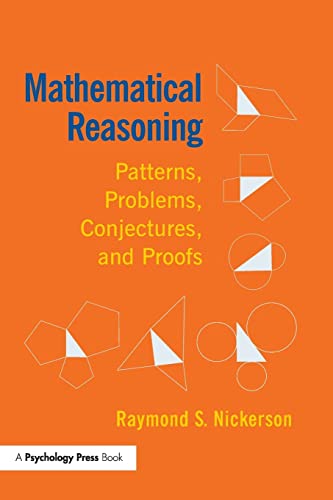
Amazon cover image
Image from Amazon.com

Mathematical Reasoning Patterns, Problems, Conjectures, and Proofs

By: Language: English Publication details: Oxford Psychology Press 20151124Edition: 1Description: 596 pISBN:
  • 9781138980587
Summary: The development of mathematical competence -- both by humans as a species over millennia and by individuals over their lifetimes -- is a fascinating aspect of human cognition. This book explores when and why the rudiments of mathematical capability first appeared among human beings, what its fundamental concepts are, and how and why it has grown into the richly branching complex of specialties that it is today. It discusses whether the ‘truths’ of mathematics are discoveries or inventions, and what prompts the emergence of concepts that appear to be descriptive of nothing in human experience. Also covered is the role of esthetics in mathematics: What exactly are mathematicians seeing when they describe a mathematical entity as ‘beautiful’? There is discussion of whether mathematical disability is distinguishable from a general cognitive deficit and whether the potential for mathematical reasoning is best developed through instruction. This volume is unique in the vast range of psychological questions it covers, as revealed in the work habits and products of numerous mathematicians. It provides fascinating reading for researchers and students with an interest in cognition in general and mathematical cognition in particular. Instructors of mathematics will also find the book’s insights illuminating.
Item type:
Tags from this library: No tags from this library for this title. Log in to add tags.
Star ratings
    Average rating: 0.0 (0 votes)
No physical items for this record

The development of mathematical competence -- both by humans as a species over millennia and by individuals over their lifetimes -- is a fascinating aspect of human cognition. This book explores when and why the rudiments of mathematical capability first appeared among human beings, what its fundamental concepts are, and how and why it has grown into the richly branching complex of specialties that it is today. It discusses whether the ‘truths’ of mathematics are discoveries or inventions, and what prompts the emergence of concepts that appear to be descriptive of nothing in human experience. Also covered is the role of esthetics in mathematics: What exactly are mathematicians seeing when they describe a mathematical entity as ‘beautiful’? There is discussion of whether mathematical disability is distinguishable from a general cognitive deficit and whether the potential for mathematical reasoning is best developed through instruction. This volume is unique in the vast range of psychological questions it covers, as revealed in the work habits and products of numerous mathematicians. It provides fascinating reading for researchers and students with an interest in cognition in general and mathematical cognition in particular. Instructors of mathematics will also find the book’s insights illuminating.

There are no comments on this title.

to post a comment.