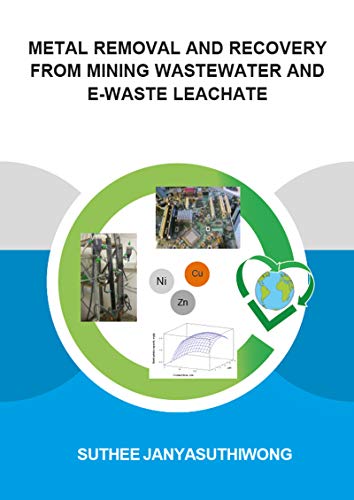
Amazon cover image
Image from Amazon.com

Metal Removal and Recovery from Mining Wastewater and E-waste Leachate

By: Language: English Publication details: CRC Press 20160919Edition: 1Description: 146 pISBN:
  • 9781138029491
Summary: Metal contamination in the environment is a persisting global issue. The metal reservoirs in the earth have declined due to society’s needs and due to uncontrolled mining activities. Therefore, the idea to recover metals from waste streams has emerged. In this thesis, cost competitive technologies such as adsorption using agro-wastes and precipitation using an inverse fluidized bed (IFB) reactor were investigated, with special emphasis on the recovery of base metals. Groundnut shell showed good potential for metal (Cu, Pb and Zn) removal. From artificial neural network modeling, the performance of the sulfate reducing bacteria (SRB) was found to be strongly pH dependent; the removal efficiency of Cu and Zn in the IFB at pH 5.0 was >97%. Electronic waste is a good candidate as secondary metal resource. The recovery of Cu from computer printed circuited boards (PCBs) using biogenic sulfide precipitation was investigated as well. Using this technology, Cu could be recovered at ~0.48 g Cu/g PCBs.
Item type:
Tags from this library: No tags from this library for this title. Log in to add tags.
Star ratings
    Average rating: 0.0 (0 votes)
No physical items for this record

Metal contamination in the environment is a persisting global issue. The metal reservoirs in the earth have declined due to society’s needs and due to uncontrolled mining activities. Therefore, the idea to recover metals from waste streams has emerged. In this thesis, cost competitive technologies such as adsorption using agro-wastes and precipitation using an inverse fluidized bed (IFB) reactor were investigated, with special emphasis on the recovery of base metals. Groundnut shell showed good potential for metal (Cu, Pb and Zn) removal. From artificial neural network modeling, the performance of the sulfate reducing bacteria (SRB) was found to be strongly pH dependent; the removal efficiency of Cu and Zn in the IFB at pH 5.0 was >97%. Electronic waste is a good candidate as secondary metal resource. The recovery of Cu from computer printed circuited boards (PCBs) using biogenic sulfide precipitation was investigated as well. Using this technology, Cu could be recovered at ~0.48 g Cu/g PCBs.

There are no comments on this title.

to post a comment.