testing all
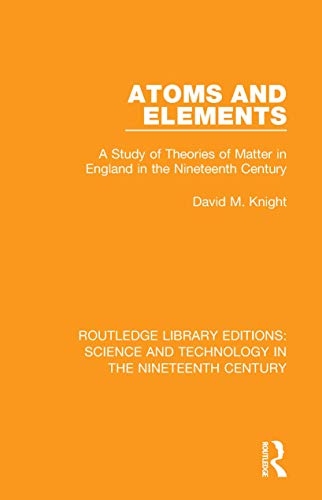
Amazon cover image
Image from Amazon.com

Atoms and Elements A Study of Theories of Matter in England in the Nineteenth Century

By: Language: English Publication details: Oxford Routledge 20200814Edition: 1Description: 178 pISBN:
  • 9781138393899
Summary: First published in 1967. The impression is sometimes given that the Atomic Theory was revived in the early years of the nineteenth century by John Dalton, and that continuously from then on it has played a vital role in chemistry. The aim of this study is to revise this over-simplified picture. Atomic explanations seemed to chemists to go beyond the facts, to fail to lend themselves to mathematical expression, and to deny the ultimate simplicity and unity of all matter. Most, therefore, rejected them. Meanwhile, physicists were developing a whole range of atomic theories to explain the physical properties of bodies in terms of very simple atoms or particles. During the last thirty years of the century the position changed, as physicists and chemists came to agree on a common atomic theory. But the last prominent opponents of atomism were not converted until the early years of the twentieth century, by which time studies of radioactivity had made it clear that the billiard-ball Daltonian atom must, in any case, be abandoned.
Item type:
Tags from this library: No tags from this library for this title. Log in to add tags.
Star ratings
    Average rating: 0.0 (0 votes)
No physical items for this record

First published in 1967. The impression is sometimes given that the Atomic Theory was revived in the early years of the nineteenth century by John Dalton, and that continuously from then on it has played a vital role in chemistry. The aim of this study is to revise this over-simplified picture. Atomic explanations seemed to chemists to go beyond the facts, to fail to lend themselves to mathematical expression, and to deny the ultimate simplicity and unity of all matter. Most, therefore, rejected them. Meanwhile, physicists were developing a whole range of atomic theories to explain the physical properties of bodies in terms of very simple atoms or particles. During the last thirty years of the century the position changed, as physicists and chemists came to agree on a common atomic theory. But the last prominent opponents of atomism were not converted until the early years of the twentieth century, by which time studies of radioactivity had made it clear that the billiard-ball Daltonian atom must, in any case, be abandoned.

There are no comments on this title.

to post a comment.