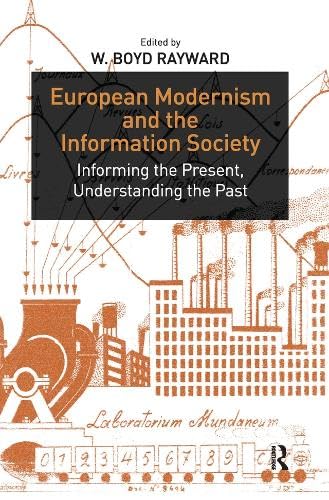
Amazon cover image
Image from Amazon.com

European Modernism and the Information Society Informing the Present, Understanding the Past

By: Language: English Publication details: Oxford Routledge 20170515Edition: 1Description: 360 pISBN:
  • 9781317139478
Summary: Uniting a team of international and interdisciplinary scholars, this volume considers the views of early twentieth-century European thinkers on the creation, dissemination and management of publicly available information. Interdisciplinary in perspective, the volume reflects the nature of the thinkers discussed, including Otto Neurath, Patrick Geddes, the English Fabians, Paul Otlet, Wilhelm Ostwald and H. G. Wells. The work also charts the interest since the latter part of the nineteenth century in finding new ways to think about and to manage the growing body of available information in order to achieve aims such as the advancement of Western civilization, the alleviation of inequalities across classes and countries, and the promotion of peaceful coexistence between nations. In doing so, the contributors provide a novel historical context for assessing widely-held assumptions about today's globalized, 'post modern' information society. This volume will interest all who are curious about the creation of a modern networked information society.
Item type:
Tags from this library: No tags from this library for this title. Log in to add tags.
Star ratings
    Average rating: 0.0 (0 votes)
No physical items for this record

Uniting a team of international and interdisciplinary scholars, this volume considers the views of early twentieth-century European thinkers on the creation, dissemination and management of publicly available information. Interdisciplinary in perspective, the volume reflects the nature of the thinkers discussed, including Otto Neurath, Patrick Geddes, the English Fabians, Paul Otlet, Wilhelm Ostwald and H. G. Wells. The work also charts the interest since the latter part of the nineteenth century in finding new ways to think about and to manage the growing body of available information in order to achieve aims such as the advancement of Western civilization, the alleviation of inequalities across classes and countries, and the promotion of peaceful coexistence between nations. In doing so, the contributors provide a novel historical context for assessing widely-held assumptions about today's globalized, 'post modern' information society. This volume will interest all who are curious about the creation of a modern networked information society.

There are no comments on this title.

to post a comment.